

The Reach is a big and perilous place, but it's also an optimistic view of a 30th century society which views our modern times and troubles as the "Second Dark Age" of mankind.
This setting is not an engine for political preaching, only the creation of engaging stories of adventure, mystery, and drama.

Human science learned much less from the remains of the Atro'me armada than they had first hoped, but what was learned still caused several revolutionary advances in the technologies used in human spacecraft. Of the technologies scavenged from the alien warships, the most lasting would be the so-called Grinner Reactor - a matter-antimatter annihilation powerplant far more capable and far more stable than previous human-built fusion systems. This device would become the power plant of the Great Expansion.
With iterative improvements on the Xiou-Edwards system and newly colossal power output of Grinner Reactors, human-crewed interstellar travel was suddenly possible in weeks or months, not years. Planet at Centauri, already the site of a permanent scientific expedition, was opened to colonial settlement within five years of the end of the Atro'me invasion, and other systems followed - systems which would become, by the end of the Expansion, the pillars of the Core Worlds.
Though expansion into the stars still had a very national characteristic, and all human settlements on far-flung worlds were still sponsored by Earthly nations, the final era of nations was already nearing its end. Human culture absorbed two lessons from its near-destruction at the hands of the Atro'me, and these lessons would spell the end of nationalism for nearly five hundred years.
Firstly, the narrative that the invasion might easily have gone differently became popular. Had the Signatories gone to war before the Atro'me fleet appeared, it was said, no intervention by the mysterious Angels would have saved Sol from being conquered. The vastness beyond was full of peril which it was said would punish any species that could not put aside its internal squabbles.
The second lesson was that no expert could predict the future. No expert or expert panel had predicted the Atro'me invasion before it occurred, and the experts had predicted destruction in the months before the Angels intervened in the conflict. Humanity's fate was, at least for a time, beyond being engineered, and the slowly sprouting seeds of the seeds planted by Reacher first contact and watered in out-of-the-way places by Earth's philosophers and religious thinkers now pushed their leaves into the light. With the death of faith in experts came a spiritual revival which swept through human culture with surprising speed.
Over the decades, the Signatories surrendered their sovereignty to a new Terran Parliament. Though member states retained their militaries, the Parliament began building its own navy, a fleet of ships designed to keep the peace and to guard the increasingly far-flung colonies.
The colonies on many worlds prospered, though by later eras' standards many of these worlds were of poor quality for colonial projects. In the early expansion, colonists would gleefully claim any world with a breathable atmosphere, even one with an inclement climate. Facing a perceived overpopulation crisis on Earth, Parliament created the Colonial Initiative, a vast agency intended to make emigration to the colonies easy for the masses, and more and more of Earth’s twenty-two billion inhabitants boarded the great colony transports for one-way voyages out into the unknown, relying on Parliament-subsidized equipment and supplies to build a new home at their destination and Parliament's navy to keep them safe from any new threats from beyond.
While some of the early colonies failed, most of these first-generation settlers prospered, and passed this prosperity on to their children and grandchildren. Their worlds - Tranquility, Hercules, Vorkuta, Yamasaki, Xianping, Madurai, and others - would go on to be the metropolitan Core Worlds of later eras, and from these worlds colonial expeditions departed for alien shores yet further afield.
Though three alien species visited Sol between first contact in 2084 and the beginning of the Great Expansion around 2300, and a small colony of carefully monitored Atro'me still lived on Eris, the Great Expansion period lacked any major encounters with alien intelligences. There are no confirmed encounters with either Angels or Reachers in the period, and neither was first contact made with any other sapient species. With its first tentative steps out to the stars so crucially altered by interactions with xenosapients, humanity found itself, at least for three centuries, all but alone among the stars.
This solitude did not encourage humans to think they had encountered all the sapients of the galaxy, however. On worlds as close to home as Planet at Centauri and as far afield as the distant paradise of Barbora, human explorers began to find relics of a millennia-dead alien culture - relics so vastly beyond human science that many defied even an understanding of their purpose. Though these enigmatic relics became highly sought-after by scientists and criminal enterprises alike, nobody knew what these extinct "Xenarchs" had been like, or what had happened to their vast empire.
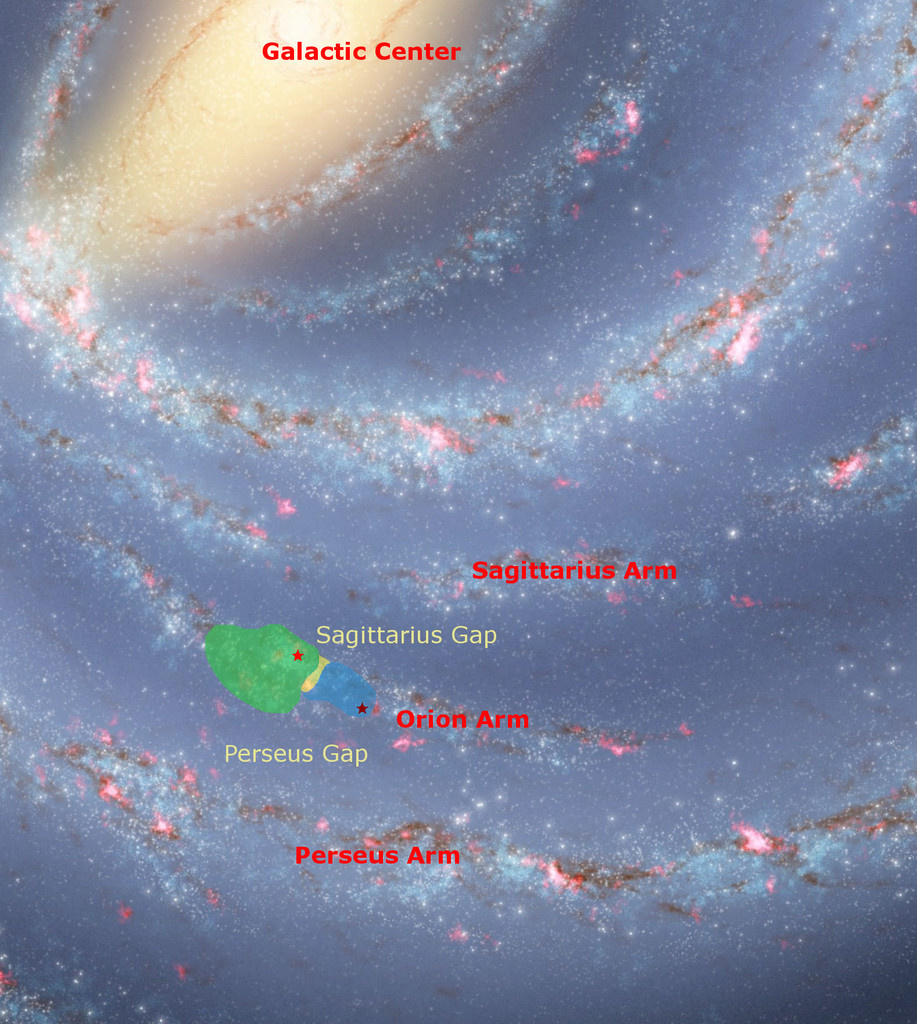
The Angels' Reach is not, in the grand scheme of the cosmos, a very big place. Stretching across a few hundred light-years of the Orion Arm of the Milky Way galaxy, the Reach is bounded by the Gaps on two sides, and grows slowly along the arm by way of the Coreward and Rimward Frontiers.
The Reach (its denizens refer to it as such) is defined by the general extent of human habitation, though some colonial expeditions do venture out into the star systems beyond the Frontiers, and even across the Gaps to the neighboring arms of the galaxy. What becomes of these brave - and perhaps foolhardy - people is not always known; some vanish without a trace, intentionally or otherwise.
By the dawn of the 30th century, the undisputed masters of this section of space are humans, but even as recently as the mid 29th century this was not the case. For two hundred years, much of what is now known as the Reach was dominated by the Rattanai Imperium, and towering, iron-boned Rattanai make up the largest...
Though the arms-race among the Signatories promised war, when that war came in 2293, it was not the one anyone expected.
The Atro'me - the Grinners, as they were known at the time - were much more like humans Reachers, and when they first appeared, this made them seem a manageable threat. Raiding the outer Kuiper Belt worlds in increasing numbers as their dispersed fleet followed the reports of the first ships, these aliens came to Sol only to plunder, destroy, and conquer. The Signatories put aside their differences to deal with what was seen as a relatively minor threat - after all, their technology was not terribly more advanced than that of mankind.
Once the main "Grinner" armada had reached Sol, the few remaining Kuiper Belt outposts fell quickly. The Signatories, forced into an uneasy alliance, joined their fleets in a desperate effort to repel the invasion. The Grinners seemed to want nothing of humanity, desiring only to conquer Sol for themselves. For two bloody years, the Signatories ...
Before the Reachers departed Earth, physicist Lin Xiou and aerospace engineer Alexander Edwards had already built their famous prototype machine based on Reacher science - a device to move between locations without crossing intervening space by folding the Cosmic Fabric upon itself. The Xiou-Edwards drive family born of their invention will remain in use (undergoing many revisions and updates) eight hundred years later, though for several generations its ability to power true faster-than-light travel was theoretical rather than practical.
The success of the Xiou-Edwards project was at first hushed up, but not for long. Against the orders of their governmental masters, these two visionaries, exposed as they were to Reacher ideas beyond the scientific, did the unthinkable - they open-sourced their invention, releasing its schematics worldwide. The few large interests still involved in the WSA pulled out to build their own space programs once more, using this technology and others derived ...