

The Reach is a big and perilous place, but it's also an optimistic view of a 30th century society which views our modern times and troubles as the "Second Dark Age" of mankind.
This setting is not an engine for political preaching, only the creation of engaging stories of adventure, mystery, and drama.

Though the arms-race among the Signatories promised war, when that war came in 2293, it was not the one anyone expected.
The Atro'me - the Grinners, as they were known at the time - were much more like humans Reachers, and when they first appeared, this made them seem a manageable threat. Raiding the outer Kuiper Belt worlds in increasing numbers as their dispersed fleet followed the reports of the first ships, these aliens came to Sol only to plunder, destroy, and conquer. The Signatories put aside their differences to deal with what was seen as a relatively minor threat - after all, their technology was not terribly more advanced than that of mankind.
Once the main "Grinner" armada had reached Sol, the few remaining Kuiper Belt outposts fell quickly. The Signatories, forced into an uneasy alliance, joined their fleets in a desperate effort to repel the invasion. The Grinners seemed to want nothing of humanity, desiring only to conquer Sol for themselves. For two bloody years, the Signatories threw their fleets at the armada, and ships of both species broke against each other in the void and in the skies over the most valuable moons of the outer system.
In time, the militaries advanced their tactics until they could fight the enemy on equal terms, but by that point there were precious few human warships remaining to defend the millions on Mars and the billions on Earth. The Grinners, too, were badly degraded, and they paused to digest their winnings. An uneasy stalemate descended on contested Sol, and the human defenders hastily built new ships and trained new crews, expecting a second alien fleet to reinforce the first for the final assault on humanity's home.
More alien ships appeared, but they were not Grinners. Small, sleek, elusive ships appeared from the void to strike and harry the Grinner fleet whenever it moved out from its safe harbor at Titan, taking a savage toll on the invaders. Never did these enigmatic vessels hail human ships. These Angels - that was what humans called them, having no knoweldge of what they called themselves - possessed technology surpassing even that of the Reachers, and though their vessels were small and relatively few in number, even the largest Grinner dreadnought was their prey.
Harried, besieged, and terrified, the Atro'me fleet broadcast appeals for protection - the protection of humans against the Angels. For all their stubborn, exterminatory warfare up to that point, the invaders begged for captivity as an alternative to death.
The admiralty of the Signatories did not accept the Grinners' surrender. Human fleets merely stood off at a safe distance and allowed the Angels to pick the last remnants of the invading armada to pieces. Once their bloody work was done, the Angels vanished as silently as they had come, and humans sifted through the wrecked ships for survivors and salvageable technology.
Of the hundreds of thousands - perhaps millions - of Atro'me who arrived in the solar system with the invading armada, about five thousand survived as prisoners, all of them low-ranking crew and junior officers. These knew little of use to their human interrogators - they couldn't even give humanity any ideas about the location of their home-world relative to Sol. The leaders of the armada had destroyed their navigation systems before killing themselves in a bid to shield their home-world from human reprisal.
This self-sacrificial bid to save their world of origin from humanity was either unexpectedly successful or futile, and humans may never know which. The Atro'me home-world was never found by human explorers, and as far as anyone in the Reach knows, the only living Atro'me are those few tens of millions descended from the five thousand captives who survived the Armada. For most of the history of the Reach, the bulk of the Atro'me population lived in a human-administered colony on the Kuiper Belt world of Eris, with individuals and small communities authorized to travel and settle elsewhere.
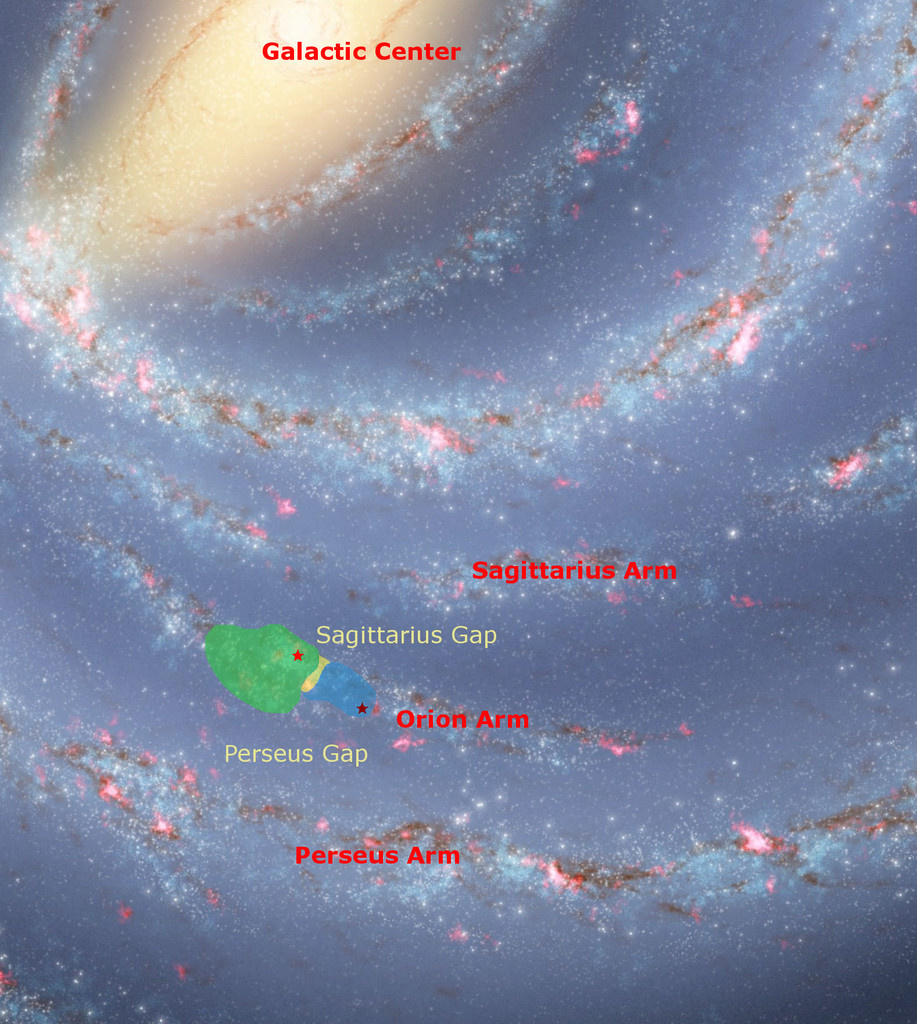
The Angels' Reach is not, in the grand scheme of the cosmos, a very big place. Stretching across a few hundred light-years of the Orion Arm of the Milky Way galaxy, the Reach is bounded by the Gaps on two sides, and grows slowly along the arm by way of the Coreward and Rimward Frontiers.
The Reach (its denizens refer to it as such) is defined by the general extent of human habitation, though some colonial expeditions do venture out into the star systems beyond the Frontiers, and even across the Gaps to the neighboring arms of the galaxy. What becomes of these brave - and perhaps foolhardy - people is not always known; some vanish without a trace, intentionally or otherwise.
By the dawn of the 30th century, the undisputed masters of this section of space are humans, but even as recently as the mid 29th century this was not the case. For two hundred years, much of what is now known as the Reach was dominated by the Rattanai Imperium, and towering, iron-boned Rattanai make up the largest...
Human science learned much less from the remains of the Atro'me armada than they had first hoped, but what was learned still caused several revolutionary advances in the technologies used in human spacecraft. Of the technologies scavenged from the alien warships, the most lasting would be the so-called Grinner Reactor - a matter-antimatter annihilation powerplant far more capable and far more stable than previous human-built fusion systems. This device would become the power plant of the Great Expansion.
With iterative improvements on the Xiou-Edwards system and newly colossal power output of Grinner Reactors, human-crewed interstellar travel was suddenly possible in weeks or months, not years. Planet at Centauri, already the site of a permanent scientific expedition, was opened to colonial settlement within five years of the end of the Atro'me invasion, and other systems followed - systems which would become, by the end of the Expansion, the pillars of the Core Worlds.
Though expansion into the ...
Before the Reachers departed Earth, physicist Lin Xiou and aerospace engineer Alexander Edwards had already built their famous prototype machine based on Reacher science - a device to move between locations without crossing intervening space by folding the Cosmic Fabric upon itself. The Xiou-Edwards drive family born of their invention will remain in use (undergoing many revisions and updates) eight hundred years later, though for several generations its ability to power true faster-than-light travel was theoretical rather than practical.
The success of the Xiou-Edwards project was at first hushed up, but not for long. Against the orders of their governmental masters, these two visionaries, exposed as they were to Reacher ideas beyond the scientific, did the unthinkable - they open-sourced their invention, releasing its schematics worldwide. The few large interests still involved in the WSA pulled out to build their own space programs once more, using this technology and others derived ...